Lust
Lust, in Dante's moral universe, is the sin of disordered sexual desire—the subjugation of reason to appetite. It is the first of the sins of Incontinence punished in Hell, and the last of the seven capital sins purged on the Mountain of Purgatory. Its treatment across the three canticles reveals a coherent theology: lust is not the worst sin, but it is the one that most directly corrupts the rational faculty that distinguishes human beings from beasts, and its purification requires the complete reorientation of love from the flesh to the divine.
Definition and Place in the Moral Order
Dante's Virgil explains the hierarchy of sin in Inferno, Canto XI, drawing on Aristotle's Ethics. The sins of Incontinence—lust, gluttony, avarice, wrath—are those that "less God offendeth, and less blame attracts" than the sins of Malice or Bestiality. Lust is the least grave of the Incontinent sins, punished in the Second Circle, the first of the circles devoted to active punishment. The carnal malefactors are those "who reason subjugate to appetite" . This definition is crucial: lust is not merely a physical act but a failure of the rational soul to govern the lower appetites. The sin is thus a violation of the natural order within the human person, where the intellect should rule the senses.
Punishment in Hell: The Infernal Hurricane
The punishment of the lustful in the Second Circle is a masterpiece of contrapasso—the principle that the punishment mirrors the sin. The souls are swept forever in an infernal hurricane, "that never rests" , which "hurtles the spirits onward in its rapine; / Whirling them round, and smiting, it molests them" (E00809-E00810). Just as in life they allowed themselves to be carried away by the tempest of passion, so in death they are carried by a literal tempest, without rest or hope. The poet compares them to starlings in winter, borne on in large bands, and to cranes chanting their lays, making a long line in the air (E00817-E00825). The souls have "no hope doth comfort them for evermore, / Not of repose, but even of lesser pain" (E00821-E00822). Among the famous figures Dante sees here are Semiramis, Dido, Cleopatra, Helen of Troy, Achilles, Paris, and Tristan (E00829-E00844). The most extended episode in this circle is the story of Paolo and Francesca, who are condemned for their adulterous love, which began while reading the story of Lancelot and Guinevere. Francesca explains that "Love, that on gentle heart doth swiftly seize, / Seized this man for the person beautiful" and that "Love has conducted us unto one death" (E00877-E00883). Their punishment is to be forever inseparable, yet forever tormented by the wind that drives them.
Purification in Purgatory: The Seventh Terrace
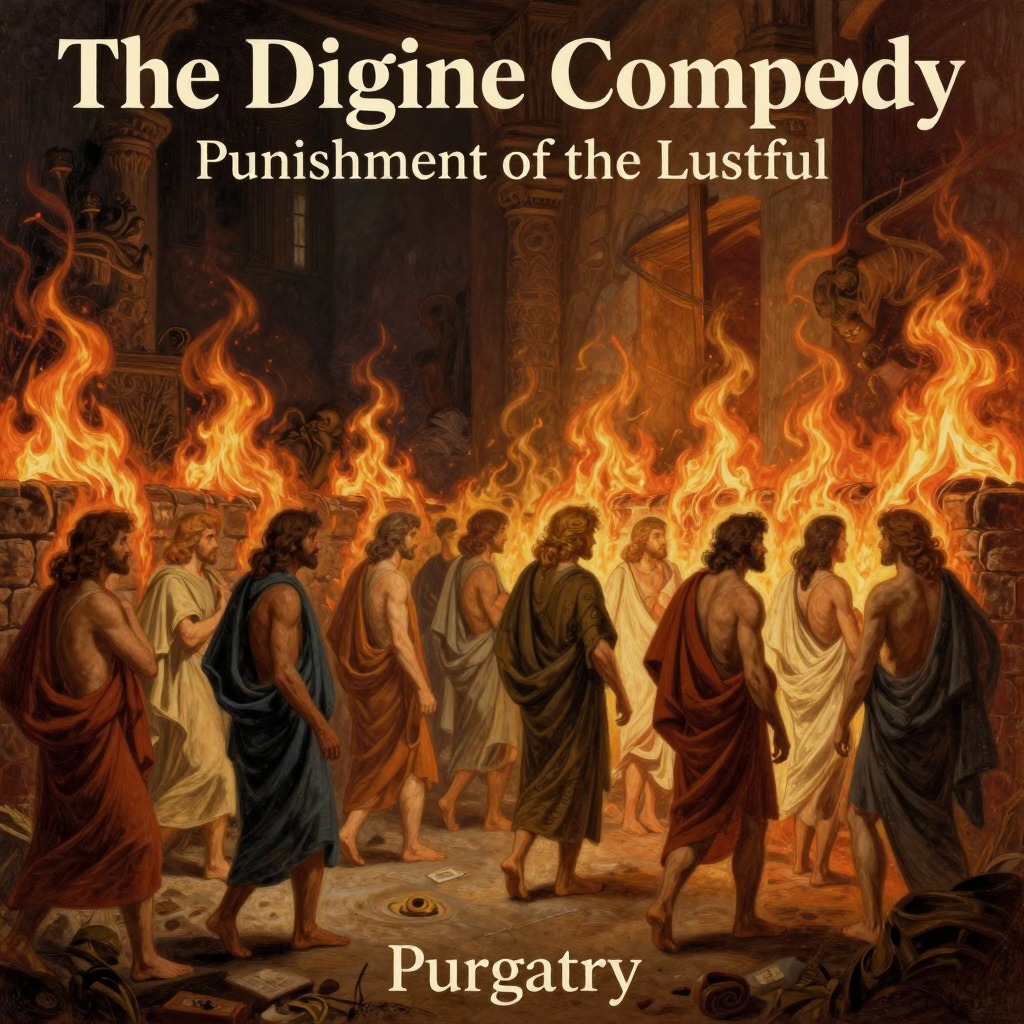
The Seventh Terrace of Purgatory is the circle of the Lustful, where the sin is purged through fire. The terrace is a wall of flame that shoots forth from the embankment, and a wind from the cornice drives the flames back, so that the penitents must walk within the fire (E08528-E08530). The souls walk through the flame, singing hymns and shouting examples of chastity. They sing "Summae Deus clementiae" and then shout "Virum non cognosco" —the words of the Virgin Mary at the Annunciation, expressing her chastity. They also recall Diana, who drove Helice from the wood because she had "felt the poison" of Venus (E08547-E08548). The penitents also shout examples of faithful wives and husbands who were chaste (E08549-E08551). The fire is the final purgation, the "last wound of all" that must be closed up (E08555-E08556). Dante himself must pass through this fire to reach the Earthly Paradise, and Virgil encourages him by saying that the fire can cause torment but not death, and that it cannot even make him bald a single hair (E08734-E08740). The name of Beatrice is the final inducement that makes Dante enter the flames (E08749-E08755).
The Two Kinds of Lustful in Purgatory
On the Seventh Terrace, the penitents are divided into two groups who walk in opposite directions, meeting and kissing each other briefly before continuing on their way (E08585-E08589). One group cries out "Sodom and Gomorrah!" , identifying themselves as those who committed homosexual acts. The other group cries out "Into the cow Pasiphae enters, / So that the bull unto her lust may run!" (E08597-E08598), identifying themselves as those who committed heterosexual excess. Guido Guinicelli, the poet whom Dante calls his "father" and "master" (E08653-E08655), explains that his group's transgression was "hermaphrodite"—that is, they followed "like unto beasts our appetite" (E08638-E08640). The two groups thus represent the two forms of lust: that which violates the natural order of sexuality (sodomy) and that which exceeds the bounds of reason within natural sexuality (heterosexual lust). Both are purified by the same fire, and both are united in their repentance.
The Theological Framework: Love and Free Will
Virgil's discourse on love in Purgatorio, Cantos XVII and XVIII, provides the theological foundation for understanding lust. Love is the seed of every virtue and every act that merits punishment (E07355-E07356). The natural love is always without error, but the spiritual love—the love that involves choice—can err by having an evil object, or by being too vigorous or too languid (E07345-E07347). Lust is the love that is too vigorous toward a good that is not the highest good—the love of sensual pleasure that exceeds the measure of reason. The soul, created apt to love, is mobile toward everything that pleases, and when it inclines toward that pleasure, love is that inclination (E07410-E07417). But the soul has the power to restrain this inclination through free will, which is the "noble virtue" that Beatrice understands (E07464-E07466). Lust, then, is a failure of the will to govern the natural inclination toward pleasure, a failure that can be corrected through the purgatorial fire that reorients love toward its proper object.
Narrative and Thematic Significance
Lust occupies a unique position in Dante's moral system. It is the least grave of the sins punished in Hell, yet it is the last sin purged in Purgatory, suggesting that it is the most deeply rooted in human nature and the most difficult to eradicate. The punishment in Hell is a passive, endless suffering, while the purification in Purgatory is an active, purposeful suffering that leads to freedom. The contrast between Francesca's romantic self-justification in Hell and Guido Guinicelli's humble confession in Purgatory illustrates the difference between the unrepentant and the penitent. Francesca speaks of love as an irresistible force that "exempts no one beloved from loving" , while Guido speaks of his sin as a failure to observe human law, following appetite like a beast (E08639-E08640). The fire of the Seventh Terrace is the same fire that burns in Hell, but in Purgatory it is a fire of love that purifies rather than a fire of wrath that punishes. The final purification of lust is thus the final purification of love itself, preparing the soul for the vision of God, who is the ultimate object of all love.